This is the time of year when you and your leadership team pick the one or two bets you think will matter most next year, put a revenue number next to each, and spend most of the conversation on market timing, pricing and who should lead the work. Those are the questions a board will ask (as they should), but they tend to leave out a decision that shapes how much of that revenue you actually get to keep, which is how the product is built and managed.
A new product puts a lot on the line long before it launches. Sales starts telling customers what is coming, the company builds next year's plan around it, and your reputation gets attached to it the first time a customer bets their own roadmap on what you promised. Meanwhile the team building it makes hundreds of choices in its first few weeks that the product will carry for as long as it exists, and very few of those choices ever come back to the team for a second look.
Foundations Are Chosen Before Anyone Calls It a Decision
When a new business bet depends on building software, teams often reach first for open source languages, frameworks, and libraries. Those foundations can let a small group ship something real in days or weeks, drawing on work that would take years to develop on their own. That's how modern software now gets built, and when Black Duck audited 947 codebases for its 2026 Open Source Security and Risk Analysis, it found open source in 98% of them. Capable people make most of those early choices quickly, because moving quickly is what you asked them to do, and more of the choices are now made by AI coding agents that suggest and install packages on a developer's behalf. So more and more of what your next product is built on gets picked before anyone in the company thinks of it as a decision.
I spent years as CEO of the Cloud Foundry Foundation watching enterprises build entire lines of business on top of open source code. IBM's Bluemix, SAP's Cloud Platform and Pivotal Cloud Foundry were very different products serving different customers, but each was built on the same open source Cloud Foundry core, and that shared foundation let each company bring a cloud platform to market far faster than it could have built one alone, and freed each to focus on what made its own offering worth choosing.
What made it work for their customers was that each company stood behind its own distribution. When something broke, the customer called IBM, SAP or Pivotal, and each of those companies had decided well before launch that it would answer for the code underneath its product, including the parts it hadn't written.
Open Source Comes "As Is"
Open source licenses are refreshingly clear about this. The MIT License, one of the most widely used, says in capital letters that the software is provided "AS IS", without warranty of any kind, and most other licenses carry similar language. I think that is a fair deal, because the people who write and maintain open source are sharing their work, and they don't owe the companies building on it a support contract or a patch timeline. It does mean, though, that the support commitment your customers need is something your company has to arrange.
Almost everything else your product leans on this heavily comes with an agreement about who answers for it. Your cloud provider has a contract, and your payment processor has a service level agreement. Open source components usually enter a product without the purchasing process that normally establishes those obligations. So when a customer eventually relies on you to keep the product secure, fix it quickly when something breaks and still support it years from now, part of what you're promising rests on components nobody at your company has agreed to maintain.
One More Question for the Planning Conversation
None of this calls for a leadership team to start reviewing dependency lists, because choosing components is the engineering team's job and should stay that way. What it does call for is one more question in the planning conversation I started with, alongside market timing, pricing and who leads the work: who stands behind what this product is built on? The answer can be a named owner on your own team with time set aside to maintain it, a vendor you pay to stand behind it, or a supported distribution, and any of them is better than leaving the question for a customer's security review to raise in the middle of the deal your plan depends on. Whatever the arrangement, the answer should make clear where maintained components will come from, who will respond when an issue emerges, and what resources back that commitment.
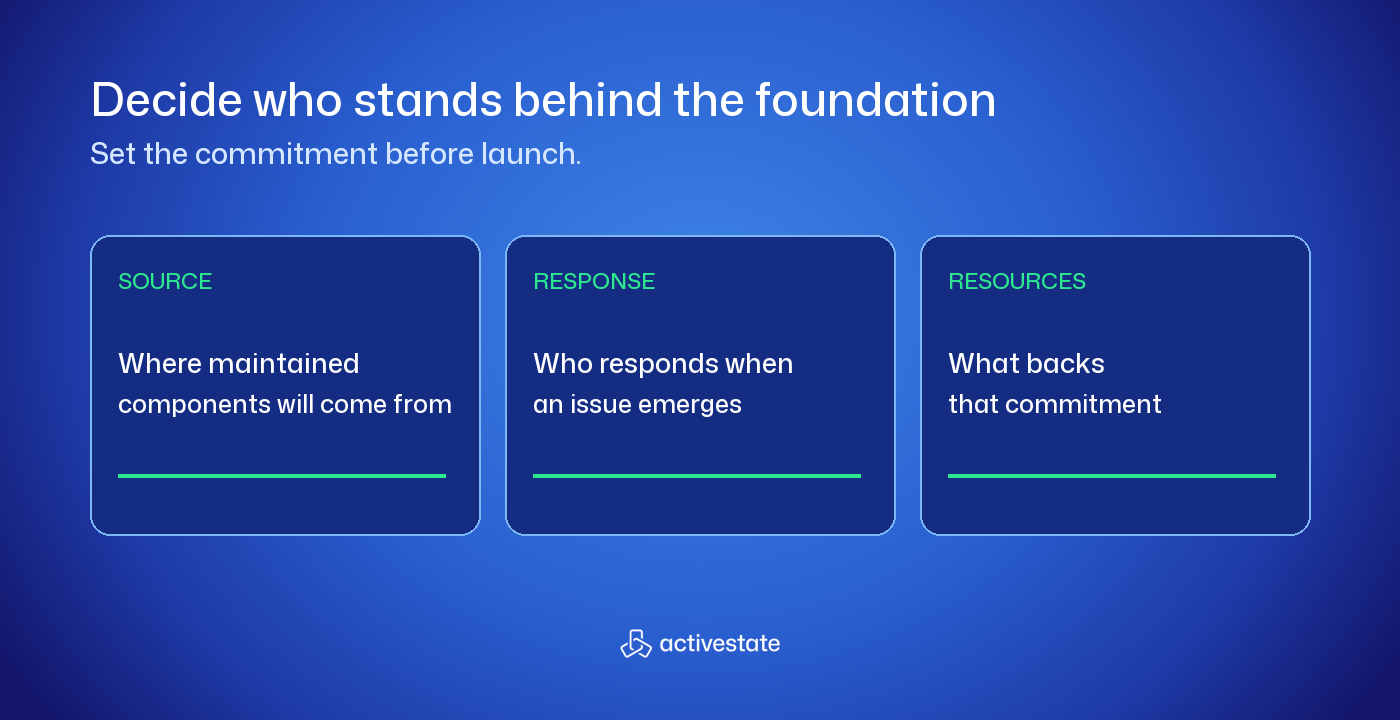
Asking it when the bet is approved, rather than at launch, also helps the team move faster, because a team that knows the answer up front can build quickly on a foundation it won't have to rework later. The companies I watched build on Cloud Foundry answered that question before they launched, and I think that's a big part of why customers were willing to bet on what they built. When a customer or the board asks who stands behind your next big idea, the best answer is one you settled before the work began.
This is the first essay in On the Line, where I'll be writing each month about the decisions that protect what your company is building. At ActiveState, we build open source packages from source, check them for vulnerabilities and malware and keep them remediated, so your teams and their AI agents can pull from open source the business can trust. You can find the series and the rest of my writing at On the Line.