Key takeaways
- Reactive security is reaching its limit: Security teams are exhausted by endless CVE triage and emergency response cycles. The industry is recognizing that faster reaction isn’t the answer; a cleaner foundation is.
- Open source is everywhere, whether teams know it or not: Many organizations lack full visibility into their open source usage, creating blind spots that can’t be secured.
- AI adoption is outpacing AI security: Teams are deploying AI tooling at speed, but the open source supply chain underneath those systems is often entirely unexamined.
- A curated, verified foundation changes the conversation: Starting from a known-good base of open source packages shifts the dynamic from reactive firefighting to proactive control.
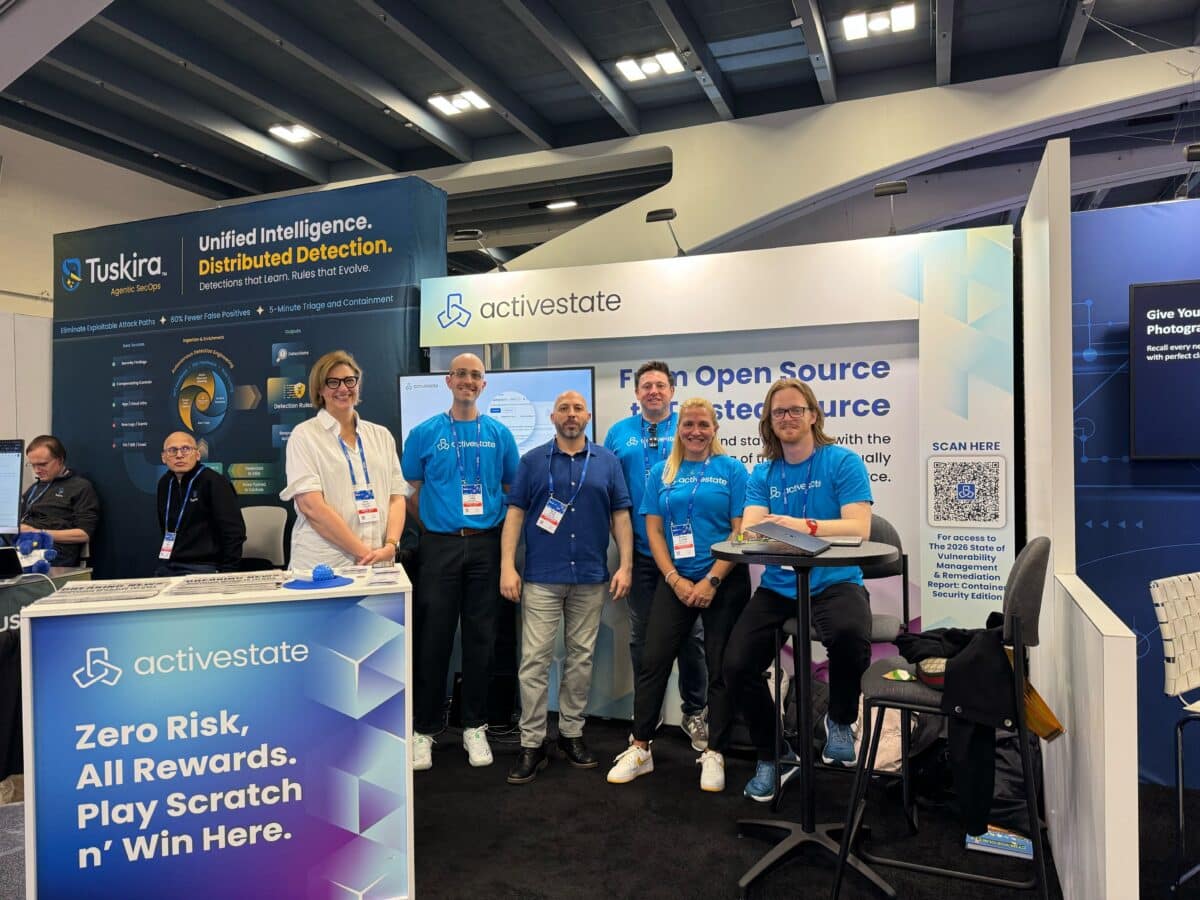
RSAC is the year’s biggest opportunity to bring together security professionals, vendors, and leaders under one roof. The conversations are energetic, the expo floor is packed and lit up with all kinds of swag and bright lights, and the sessions are dense with insight. As we reflect on RSAC 2026, there were some recurring themes and key takeaways that emerged from the great conversations we had.
The Industry Is Exhausted From Fighting Fires
One particular conversation stood out more than almost any other on the show floor. A security leader, someone who has seen it all, when asked what is a key challenge they face with open source security, looked up, and said something that stuck with us: “I’m just tired of getting emergency calls on my time off”.
That sentiment likely wasn’t unique to him. Across the show floor, security professionals are voicing the same frustration: the work never stops, and the remediation never shrinks. Patch this, triage that, respond, repeat. It’s not that teams aren’t working hard but that the model itself keeps generating more work than it resolves.
What gets talked about less, though, is the upstream question: why are teams perpetually in reactive mode in the first place? The answer often starts much earlier in the process than most people think.
When the foundation you’re building on carries unexamined risk from the start, downstream patching can only do so much. The path to fewer emergency calls isn’t necessarily faster response but rather reducing what needs to be responded to in the first place.
“We Don’t Use Open Source” — Said No One, Actually
One of the more revealing patterns at RSAC 2026 was a simple question we kept asking attendees: How do you manage your open source usage?
The initial answers were sometimes surprising. “We don’t really use open source,” was said more than a few times.
Then came the follow-up questions. What languages are your teams coding in? What does your build pipeline look like? What libraries are in your applications?
And then the light bulb moment: “Oh. I guess we do use open source. A lot of it.”
This shows just how deeply open source has become the invisible infrastructure of modern software. It’s everywhere, and it’s often untracked. The problem isn’t that teams are using open source, it’s that many organizations lack full visibility into what they’re running, where it came from, and what known risks it carries.
You can’t secure what you can’t see. And at RSAC 2026, it was clear that a significant portion of the industry is still working on that basic visibility problem.
AI Was Everywhere. The Security Around It? Less So.
No recap of RSAC 2026 would be complete without addressing the elephant (or more accurately, the entire herd of elephants in the room): artificial intelligence (AI).
AI dominated the conference. Vendor booths, session tracks, hallway conversations — it was impossible to go 5 minutes without the topic coming up. That’s not surprising. What was surprising, and a little alarming, was a pattern that emerged when Activators talked with teams who had already rolled out AI agents and tooling inside their organizations.
The sequence went something like this: business needs identified, AI tools adopted, teams integrated and moving fast. And then, somewhere downstream, someone asks: wait, what open source packages is this AI system actually pulling in? Has anyone audited the dependencies in this model pipeline? Do we know what’s running underneath all of this?
The answer, far too often, was no.
Teams are implementing AI at speed and understandably so, given competitive pressures. But the open source software supply chain sitting beneath those AI systems is, in many cases, entirely unexamined. The attack surface that comes with AI-adjacent open source packages is real, it’s growing, and the industry is only beginning to reckon with it.
It was the most energizing topic on the floor. It was also quietly one of the most concerning.
A Different Kind of Conversation: The Curated Catalog
Amid all of this, some of the most meaningful conversations we had at RSAC centered on a different approach entirely with one that starts before the vulnerabilities pile up.
When we talked with attendees about the ActiveState Curated Catalog, something shifted in those conversations. Rather than the familiar back-and-forth about patching strategies and CVE backlogs, people started talking about what it would mean to start from a place of confidence with a pre-vetted, actively maintained collection of 79 million secure open source components in 12+ languages that are known-good from the moment they’re pulled in.
For teams already feeling the weight of reactive security, that idea landed with genuine relief as they saw the path to shrinking the surface area of the problem before it ever reaches the triage queue.
The AI connection was hard to miss, too. As teams grapple with the open source complexity introduced by AI tooling and agent frameworks, the appeal of a curated, verified foundation becomes even more relevant. When you don’t have full visibility into what your AI systems are pulling in, having a trusted catalog to anchor to is exactly the kind of proactive control people are looking for.
The Through-Line: Proactive vs. Reactive
If there’s a single thread connecting all of these conversations, from the burnout, the open source blind spots, to the AI security gap, it’s the tension between reactive and proactive security.
The industry has spent years getting very, very good at responding to problems. Incident response, patch management, and CVE triage are mature disciplines. But the energy at RSAC 2026 suggested that people are starting to recognize the ceiling of the reactive approach. You cannot patch your way to a secure organization. You cannot triage your way out of a software supply chain problem that was baked in before the first line of code was deployed.
The conversations that we’re starting to hear are about what it means to be intentional from the start. Clean, verified, known-good open source as the baseline. Visibility into dependencies before they become vulnerabilities. Security built into the foundation rather than bolted on after the fact.
RSAC 2026 made one thing clear: the industry knows what the problems are. The next question is whether we’re ready to change the patterns that keep creating them.
If you’re ready to break the reactive remediation cycle, let’s talk.
THE 2026 STATE OF VULNERABILITY MANAGEMENT | CONTAINER SECURITY EDITION
Frequently Asked Questions
These are the questions security leaders need clear answers to when evaluating container hardening.
Three themes dominated the conversations on the floor: the growing exhaustion with reactive security practices, widespread blind spots around open source usage, and the rapid adoption of AI tooling without a corresponding focus on the security of the open source supply chain underneath it.
The reactive model — patch, triage, respond, repeat — generates more work than it resolves. Teams are skilled at responding to problems, but when vulnerabilities are baked into the foundation from the start, the queue never really shrinks. The result is a cycle of emergency responses that leaves little room for strategic, proactive work.
More than you might expect. At RSAC, a number of attendees initially said they didn't use open source — but when we dug into their tech stacks and build pipelines, it became clear they were relying on it heavily. Open source is so deeply embedded in modern software development that it often goes untracked. That invisibility is itself a security risk.
AI tools and agent frameworks typically rely on a significant number of open source packages — and those dependencies are often pulled in quickly, without the same scrutiny applied to other parts of the stack. Teams are moving fast to implement AI, but the supply chain security of those systems is frequently an afterthought. That gap is growing as AI adoption accelerates.
The ActiveState Curated Catalog is a pre-validated, actively maintained collection of open source packages that are verified as known-good before they ever reach a development environment. At RSAC, it resonated because it directly addresses two pain points teams are feeling right now: the burden of reactive CVE management, and the need for a trustworthy open source foundation for AI systems. Rather than scrambling to secure what's already in place, a curated catalog lets teams start from a position of confidence.